

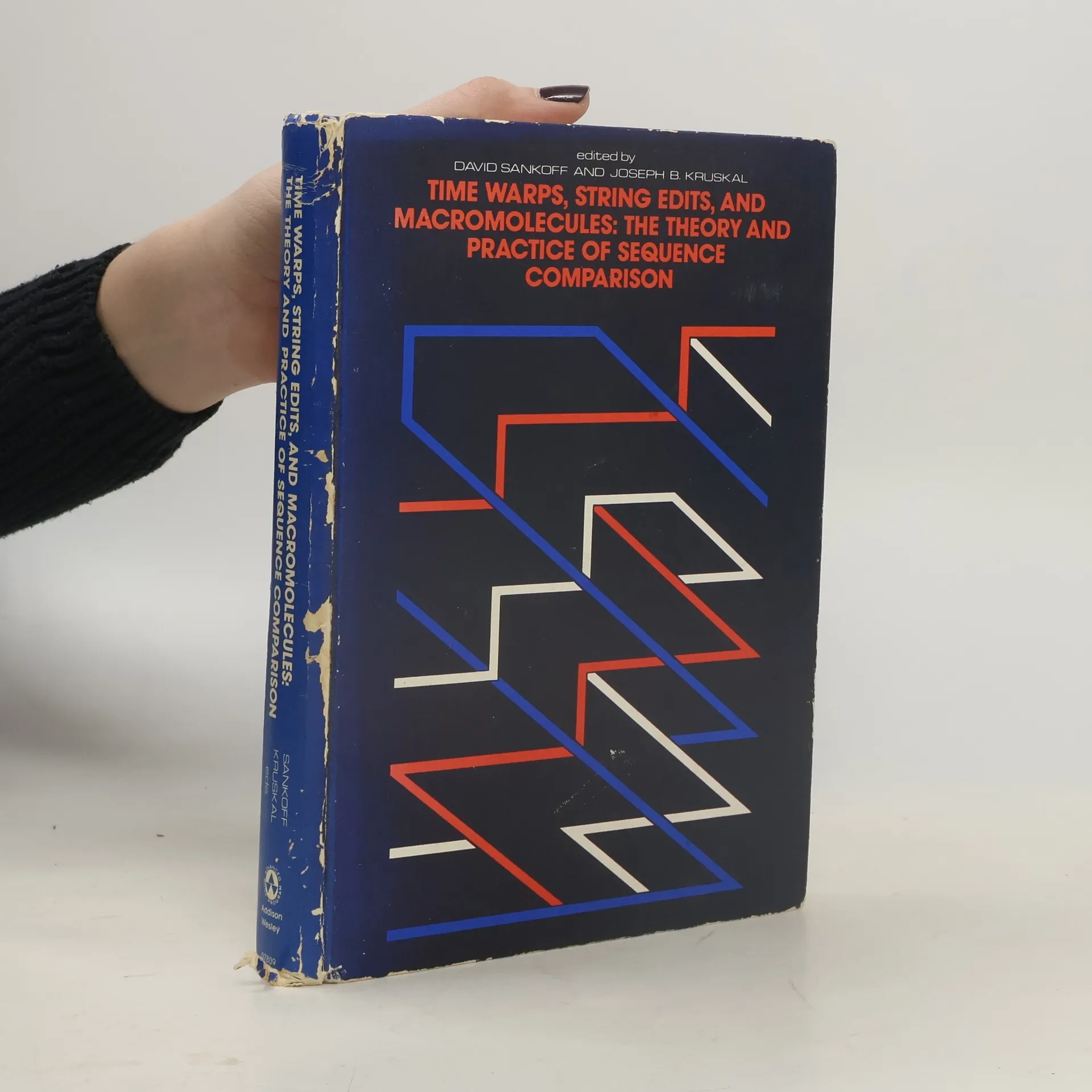
Time Warps, String Edits, and Macromolecules
The Theory and Practice of Sequence Comparison
En savoir plus sur le livre
Time Warps, String Edits and Macromolecules is a young classic in computational science. The computational perspective is that of sequence processing, in particular the problem of recognizing related sequences. The book is the first, and still best compilation of papers explaining how to measure distance between sequences, and how to compute that measure effectively. This is called string distance, Levenshtein distance, or edit distance. The book contains lucid explanations of the basic techniques; well-annotated examples of applications; mathematical analysis of its computational (algorithmic) complexity; and extensive discussion of the variants needed for weighted measures, timed sequences (songs), applications to continuous data, comparison of multiple sequences and extensions to tree-structures. This theory finds applications in molecular biology, speech recognition, analysis of bird song and error correcting in computer software.
Achat du livre
Time Warps, String Edits, and Macromolecules, David Sankoff, Joseph B. Kruskal
- Langue

- Année de publication
- 1983
- Reliure
- (rigide)
Modes de paiement
Personne n'a encore évalué .
- Titre
- Time Warps, String Edits, and Macromolecules
- Sous-titre
- The Theory and Practice of Sequence Comparison
- Langue
- Anglais
- Auteurs
- David Sankoff, Joseph B. Kruskal
- Éditeur
- Addison-Wesley
- Publié
- 1983
- Format
- rigide
- Pages
- 382
- ISBN10
- 0201078090
- ISBN13
- 9780201078091
- Séries
- Mots clés
- États-Unis, Biologie moléculaire
- Description
- Time Warps, String Edits and Macromolecules is a young classic in computational science. The computational perspective is that of sequence processing, in particular the problem of recognizing related sequences. The book is the first, and still best compilation of papers explaining how to measure distance between sequences, and how to compute that measure effectively. This is called string distance, Levenshtein distance, or edit distance. The book contains lucid explanations of the basic techniques; well-annotated examples of applications; mathematical analysis of its computational (algorithmic) complexity; and extensive discussion of the variants needed for weighted measures, timed sequences (songs), applications to continuous data, comparison of multiple sequences and extensions to tree-structures. This theory finds applications in molecular biology, speech recognition, analysis of bird song and error correcting in computer software.