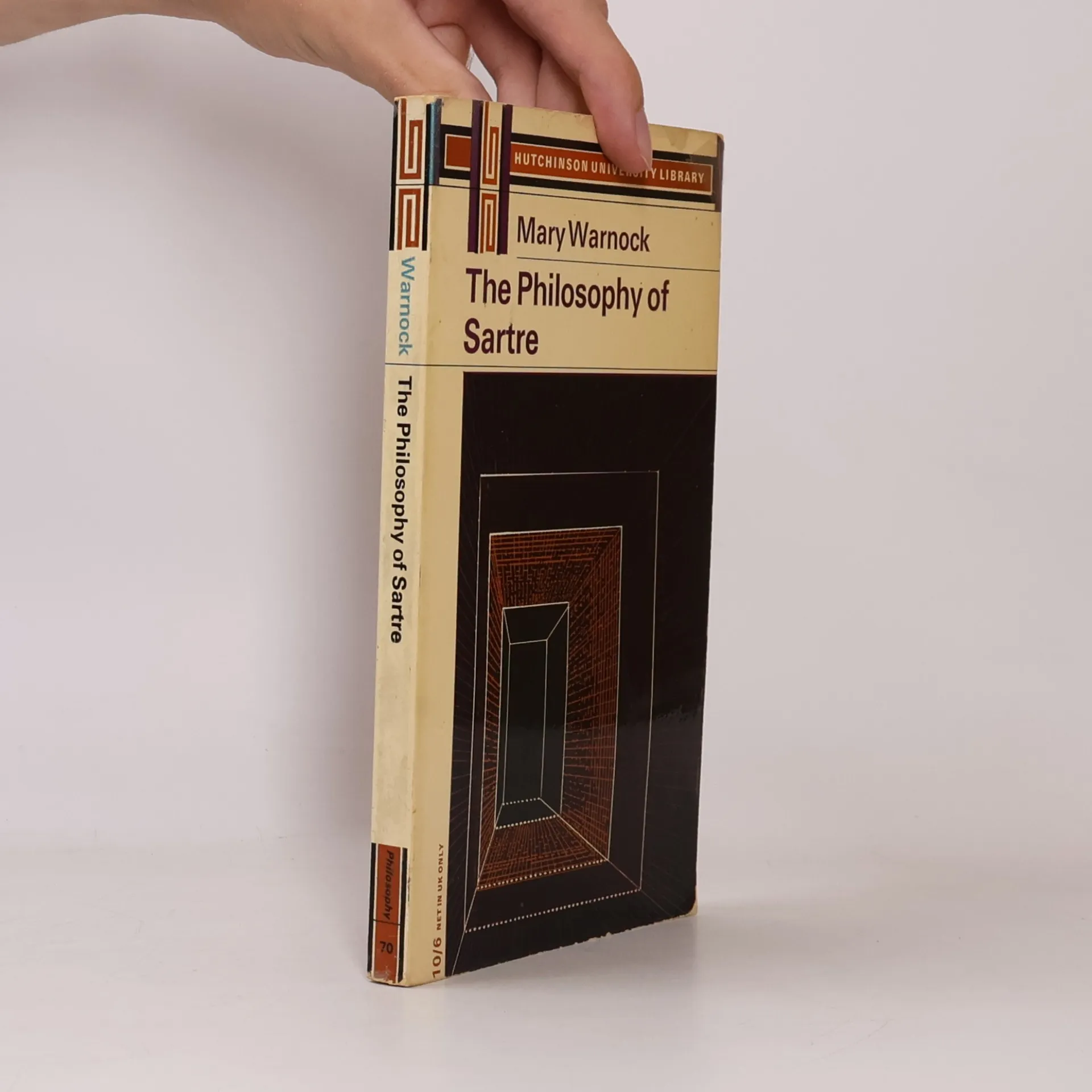
Helen Mary Warnock était une philosophe et écrivaine britannique, dont l'œuvre explorait la moralité, l'éducation et la philosophie de l'esprit. Elle était particulièrement connue pour ses écrits sur l'existentialisme. Son travail aborde de profondes questions éthiques et les complexités de la pensée humaine. Les lecteurs apprécient sa rigueur intellectuelle et sa perspective perspicace sur la condition humaine.
This selection consists of extracts from writings of women concerned solely with the pursuit of abstract ideas, historically contextualized. The texts, for the most part, reflect issues widely debated in their contemporary societies. Extracts from lesser-known writers are also included, providing a diversity of arguments spanning four centuries and including some notable contemporary philosophers.
Ce chef-d'oeuvre de la philosophie française de tradition cartésienne, devenu le livre culte des existentialistes, porte l'empreinte d'un dialogue critique avec la philosophie allemande (Hegel, Husserl, Heidegger). À la phénoménologie, il emprunte son vocabulaire technique, mais aussi les sophistications d'une méthode visant à dévoiler "l'être de la conscience". Toutefois, les pages consacrées à la description des comportements de mauvaise foi sont d'un abord plus facile. Sartre excelle dans le récit de situations qui révèlent les ruses de la conscience qui se ment à elle-même. Ainsi, le garçon de café qui se prend pour un garçon de café, sans chercher à réaliser son être autrement, parvient à fuir liberté et angoisse. De même, la femme qui abandonne son bras comme une chose morte entre les mains de l'homme qui la désire, tout en lui tenant des propos éthérés, cherche à s'affranchir des affres de la décision.
This is an indictment of government education policy presenting an alternative strategy for maintaining Britain's universities. Dame Warnock, Mistress of Girton College, Cambridge, provides an informed critique of current DES/Government orthodoxy, that is, the insistence on both higher standards and greater economic efficiency and contends that Britain's higher education system will be eroded if universities are made to run themselves like commercial companies. She speaks out against cuts in government subsidies to university research work and is in favour of nourishing "intellectual free enterprise". The author also wrote " What Must we Teach?", "Education - A Way Forward" and "A Common Policy For Education".
Existentialism enjoyed great popularity in the 1940s and 1950s, and has probably had a greater impact upon literature than any other kind of philosophy. The common interest which unites Existentialist philosophers is their interest in human freedom. Readers of Existentialist philosophy are being asked, not merely to contemplate the nature of freedom, but to experience freedom, and to practise it. In this survey, Mary Warnock begins by considering the ethical origins of Existentialism, with particular reference to Kierkegaard and Nietzsche, and outlines the importance of a systematic account of man's connection with the world as expounded by Husserl. She discusses at length the common interests and ancestry of Existentialism in the works of Heidegger, Merleau-Ponty, and Sartre, and offers some conclusions about the current nature and future of this committed and practical philosophy. This revised edition includes a postscript reviewing the status of Existentialism in the 1990s, and has a thoroughly updated bibliography.