

Artificial intelligence (AI) is reshaping many aspects of human life, prompting essential questions about its intelligence, capabilities, risks, and opportunities. This book seeks to clarify what AI truly is, debunking myths while providing a balanced perspective on its impact. Instead of following fleeting trends, the focus is on the core principles that define AI, tracing its evolution from early pioneers like Alan Turing to today’s advanced systems. Currently, AI operates within the realm of narrow intelligence, excelling at specific tasks but not replicating human cognition. Its capacity to process vast amounts of data, predict behaviors, and generate creative content is transforming industries such as healthcare and finance. Central to AI's advancement is machine learning, especially neural networks, which prioritize data-driven training over traditional scientific theories. However, this progress brings challenges: environmental costs, job market disruptions, ethical dilemmas, and the black box problem, which raises concerns about trust and accountability. AI's influence extends to global power dynamics, affecting governance, security, and democracy. Leading nations in AI development gain strategic advantages, but without careful regulation, AI could exacerbate inequality and surveillance. Ultimately, the goal is to provide a critical framework for understanding this technological revolution, fostering awareness to ensur
Alfio Quarteroni Livres

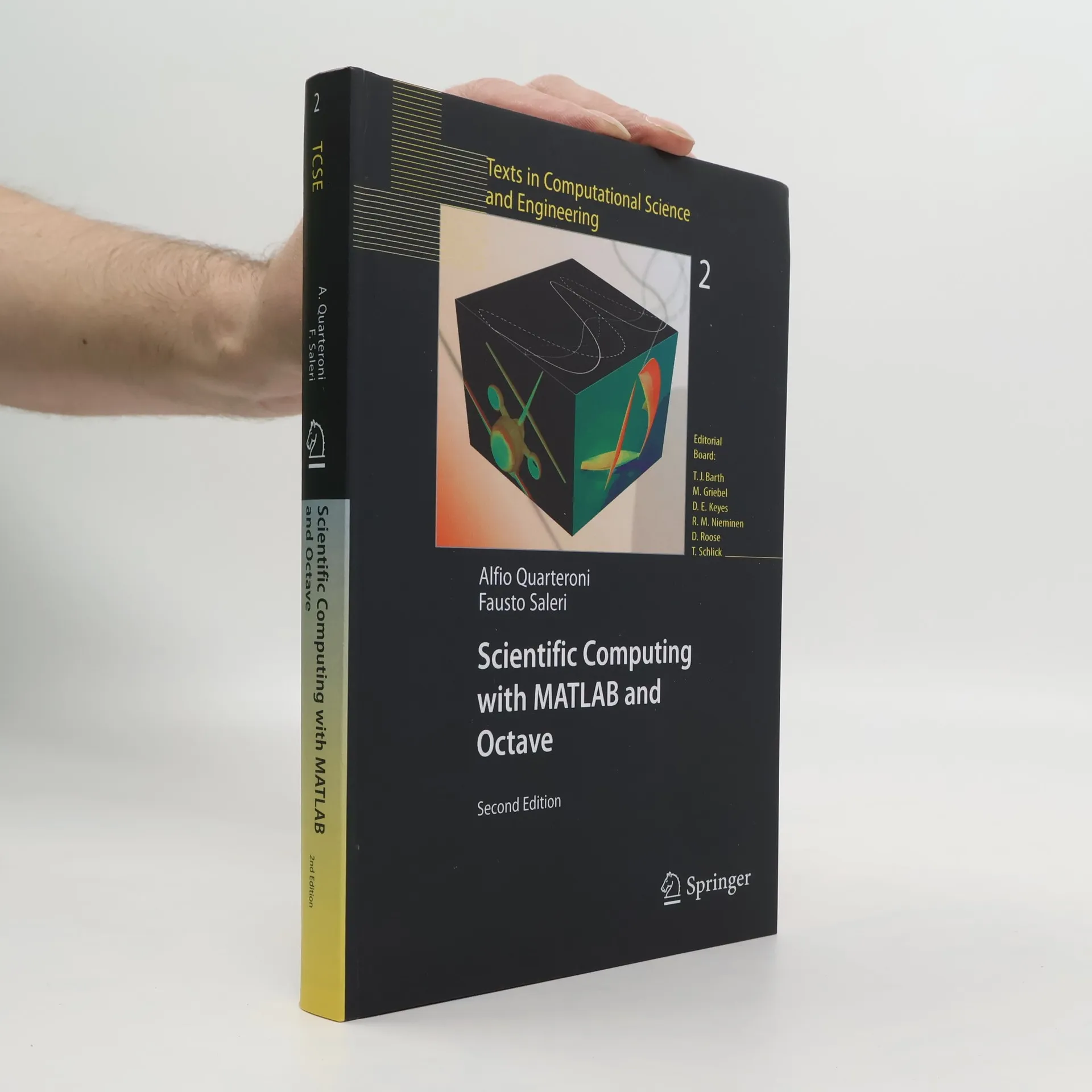
Scientific computing with MATLAB and Octave
- 318pages
- 12 heures de lecture
This introduction to Scientific Computing illustrates several numerical methods for the computer solution of certain classes of mathematical problems. The authors show how to compute the zeros or the integrals of continuous functions, solve linear systems, approximate functions by polynomials and construct accurate approximations for the solution of differential equations. To make the presentation concrete, the programming environment Matlab is adopted as a faithful companion.
Modeling Reality with Mathematics
- 142pages
- 5 heures de lecture
Simulating the behavior of a human heart, predicting tomorrow's weather, optimizing the aerodynamics of a sailboat, finding the ideal cooking time for a hamburger: to solve these problems, cardiologists, meteorologists, sportsmen, and engineers can count on math help.
Modellieren der Realität mit Mathematik
- 160pages
- 6 heures de lecture
Mathematik spielt eine entscheidende Rolle bei der Lösung vielfältiger Herausforderungen, von der Herzsimulation über Wettervorhersagen bis hin zur Optimierung von Sportgeräten. Das Buch eröffnet eine faszinierende Welt, in der Gleichungen nicht nur abstrakte Konzepte sind, sondern praktische Werkzeuge zur Bewältigung alltäglicher Probleme bieten. Leser werden eingeladen, die vielseitigen Anwendungen der Mathematik zu entdecken und deren Bedeutung für verschiedene Fachgebiete zu erkennen.