

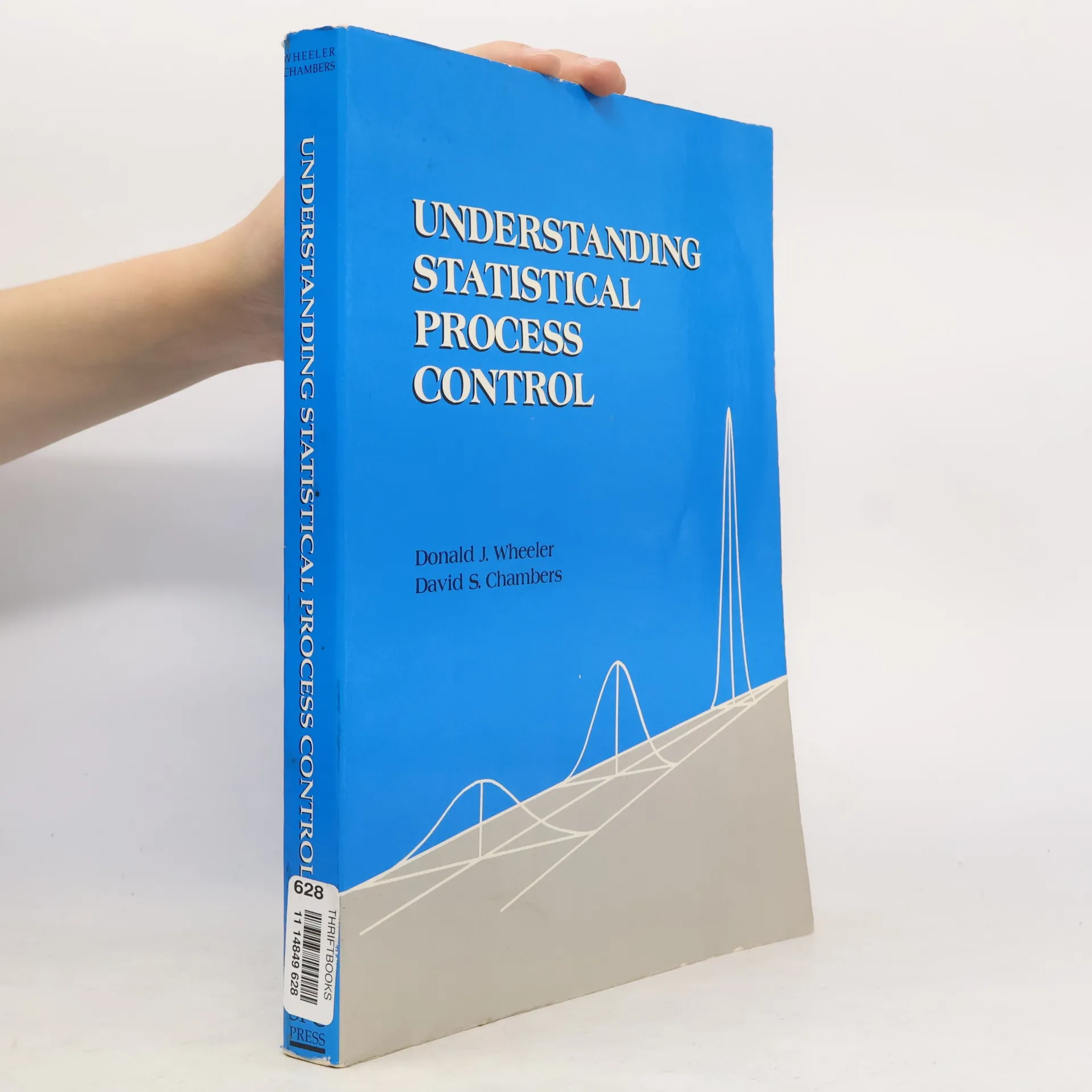


Understanding Statistical Process Control
En savoir plus sur le livre
This internationally acclaimed textbook is widely used for teaching basic SPC, Data Analysis, and Continual Improvement Techniques to those who work in manufacturing and process industries. Over 75 years of practical experience were distilled in this book which combines instruction with real-world case studies. Written in ordinary language, the book is easy to read and appropriate for self study. W. Edwards Deming wrote in his foreword, It is fitting to add my deep appreciation for the mathematical achievements of Dr. Wheeler. His understanding of theory, and its application, is guided by mathematical knowledge. Some of he unique material in this landmark text how charts signal inadequate measurement discrimination; how to use count data effectively; what happens if the measurements are not normally distributed; the right and wrong ways to assess capability; how to use process behavior charts with chemical batches; the right ways to compute limits for process behavior charts; principles of subgrouping; World-Class Quality and the Taguchi Loss Function.
Édition

Achat du livre
Understanding Statistical Process Control, Donald J. Wheeler, David S. Chambers
- Langue

- Année de publication
- 1986
- Reliure
- (souple)
Modes de paiement
Personne n'a encore évalué .
- Titre
- Understanding Statistical Process Control
- Langue
- Anglais
- Auteurs
- Donald J. Wheeler, David S. Chambers
- Publié
- 1986
- Format
- souple
- Pages
- 340
- ISBN10
- 0945320019
- ISBN13
- 9780945320012
- Séries
- Catégories
- Mots clés
- Commerce, Sciences naturelles, Science
- Description
- This internationally acclaimed textbook is widely used for teaching basic SPC, Data Analysis, and Continual Improvement Techniques to those who work in manufacturing and process industries. Over 75 years of practical experience were distilled in this book which combines instruction with real-world case studies. Written in ordinary language, the book is easy to read and appropriate for self study. W. Edwards Deming wrote in his foreword, It is fitting to add my deep appreciation for the mathematical achievements of Dr. Wheeler. His understanding of theory, and its application, is guided by mathematical knowledge. Some of he unique material in this landmark text how charts signal inadequate measurement discrimination; how to use count data effectively; what happens if the measurements are not normally distributed; the right and wrong ways to assess capability; how to use process behavior charts with chemical batches; the right ways to compute limits for process behavior charts; principles of subgrouping; World-Class Quality and the Taguchi Loss Function.