



En savoir plus sur le livre
What is biophysics? As with all subjects which straddle traditional boundaries between fields, it eludes a precise definition. Furthermore, it is impossible to do biophysics without having a certain foundation of knowledge in biology, physics, physical chemistry, chemistry and biochemistry. One approach to a biophysics textbook would be to refer the student to the literature of these neighboring fields, and to leave the selection of the appropriate supplementary material up to the student. The editors of this volume are of the opinion that it is more useful and less time-consuming to present a selection of the supplementary knowledge, in concentrated form, together with the subject matter specific to biophysics. The reader will thus find in this book introductions to such subjects as the structure and function of the cell, the chemical structure of biogenic macromolecules, and even theoretical chemistry. What, indeed, is biophysics? Must we consider it to include physiology, electromedicine, radiation medicine, etc. ? The field has evolved continuously in recent years. Molecular understanding oflife processes has come more and more to the fore. Just as the field of molecular physics has developed to describe structures and processes in the realm of non-living systems, there has been a corresponding development of molecular biophysics.

Achat du livre
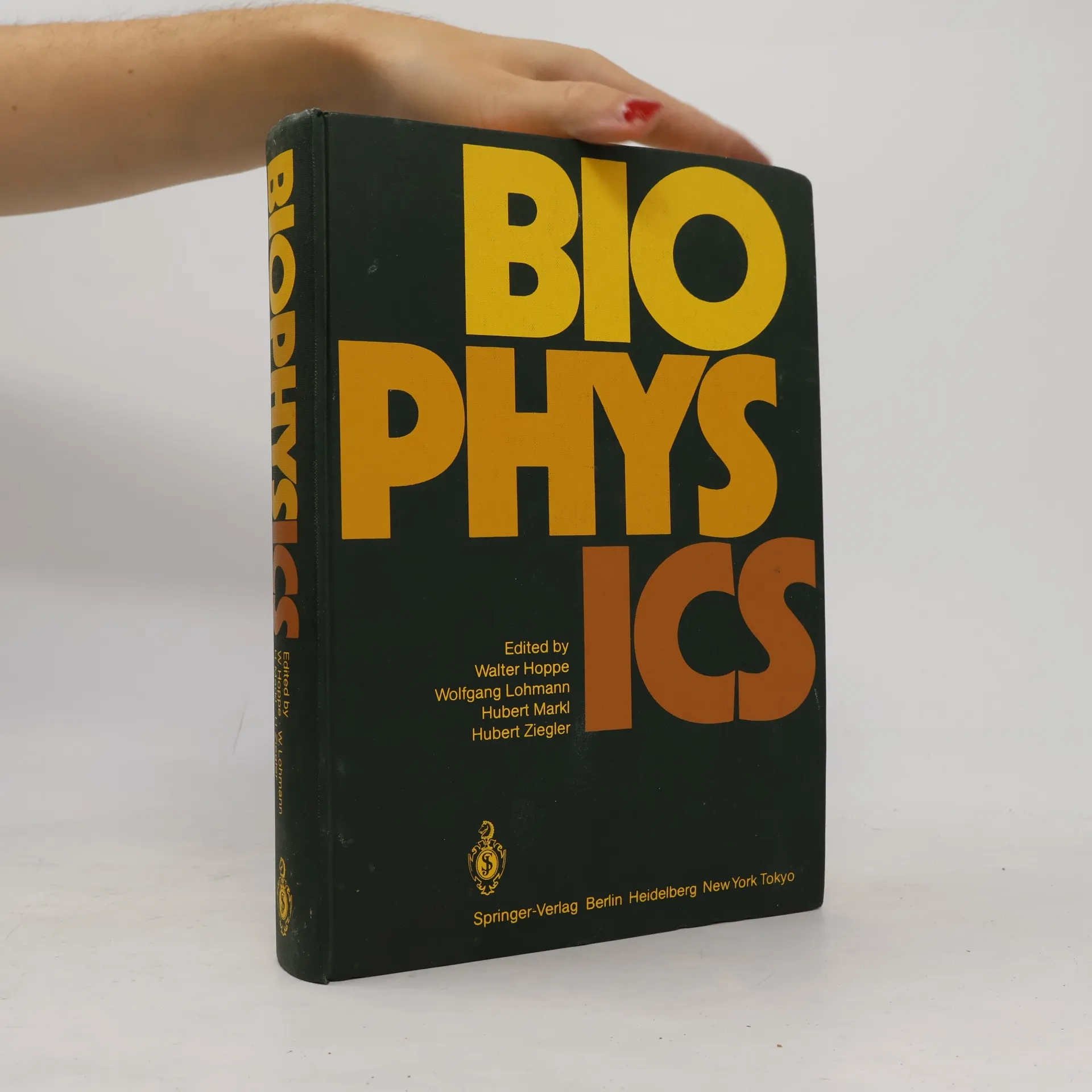
Biophysics, Walter Hoppe, Wolfgang Lohmann, Hubert Markl, Hubert Ziegler
- Langue

- Année de publication
- 1983
- Reliure
- (rigide)
Modes de paiement
Personne n'a encore évalué .
- Titre
- Biophysics
- Langue
- Anglais
- Éditeur
- Springer
- Publié
- 1983
- Format
- rigide
- Pages
- 941
- ISBN10
- 3540120831
- ISBN13
- 9783540120834
- Séries
- Description
- What is biophysics? As with all subjects which straddle traditional boundaries between fields, it eludes a precise definition. Furthermore, it is impossible to do biophysics without having a certain foundation of knowledge in biology, physics, physical chemistry, chemistry and biochemistry. One approach to a biophysics textbook would be to refer the student to the literature of these neighboring fields, and to leave the selection of the appropriate supplementary material up to the student. The editors of this volume are of the opinion that it is more useful and less time-consuming to present a selection of the supplementary knowledge, in concentrated form, together with the subject matter specific to biophysics. The reader will thus find in this book introductions to such subjects as the structure and function of the cell, the chemical structure of biogenic macromolecules, and even theoretical chemistry. What, indeed, is biophysics? Must we consider it to include physiology, electromedicine, radiation medicine, etc. ? The field has evolved continuously in recent years. Molecular understanding oflife processes has come more and more to the fore. Just as the field of molecular physics has developed to describe structures and processes in the realm of non-living systems, there has been a corresponding development of molecular biophysics.