Reiner Schürmann est allemand, il refuse d'épouser notre monde. Non pas pour l'oublier, mais précisément pour se souvenir. Se souvenir des événements, et de leur horreur, bien sûr, mais surtout de cette part d'incompréhensible dans l'agencement ontologique de la modernité, et qui menacera de faire retour si l'on n'entreprend pas de faire l'anamnèse de son origine. Récit autobiographique, Les origines sont donc aussi une interrogation sur le fondement de notre société et de notre culture occidentales.
Through the lenses of Kant, Nietzsche, and Heidegger, this edited volume traces the development of the relation between the will and the law as self-given. Modern Philosophies of the Will explores a variety of topics including: the ontological turn in philosophy of the will; the will’s playful character and the problem of teleology; the will as principle of morality as discussed by Kant, of lifeforms as discussed by Nietzsche, and of technology as discussed by Heidegger; the formal identity of legislation; and transgression of the law. This volume traces three strategies in the development of the philosophy of will from Kant to Heidegger, through rationality and irrationality of the will, the ontological turn, and law.
In this book, Reiner Schürmann argues that what is most original about Marx is his philosophical axis. Extending his highly original engagement with the history of philosophy, Schürmann draws out this axis, which determines and localizes his theories of history, social relations, and economy. Whereas Marxist readings of Marx conceive history, classes, and social relations as primary realities, Schürmann brings out a radically immanent understanding of praxis that introduces multiplicity. This edition is complemented by a reprinting of Schürmann’s Anti-Humanism essay, in which he reads Marx alongside Nietzsche and Heidegger as spelling out the dissociation of being and action. Reading Marx showcases underappreciated facets of Schürmann’s work and offers an interpretation of Marx that resonates with the readings of Jacques Derrida, Michel Henry, Antonio Negri, and François Laruelle.
In Being and Time , Heidegger announced the “Task of Destroying the History of Ontology” in order to free what had remained “unthought” in Western metaphysics. The unpublished part of that work was to be titled “Basic Features of a Phenomenological Destruction of the History of Ontology. According to the Guiding Thread of the Problem of Temporality.” This latest work in the Reiner Schürmann Selected Writings and Lecture Notes series aims to carry out Heidegger’s plan. The destruction, or, as it is later called, the deconstruction of metaphysics, has a negative side—the peeling off, or the archeology, of metaphysical history by means of the guiding thread of the question of Being—and a positive side—“retrieval” of the original experience of Being in ancient Greek philosophy. “The destruction has no other intent than to win back the original experience of metaphysics through a deconstruction of those conceptions which have become current and empty.” The purpose of taking to pieces the fabric of Western metaphysics is to show how at each important stage “the question of the meaning of Being has not only remained unattended to or inadequately raised, but that it has become quite forgotten in spite of all our interest in 'metaphysics'.”
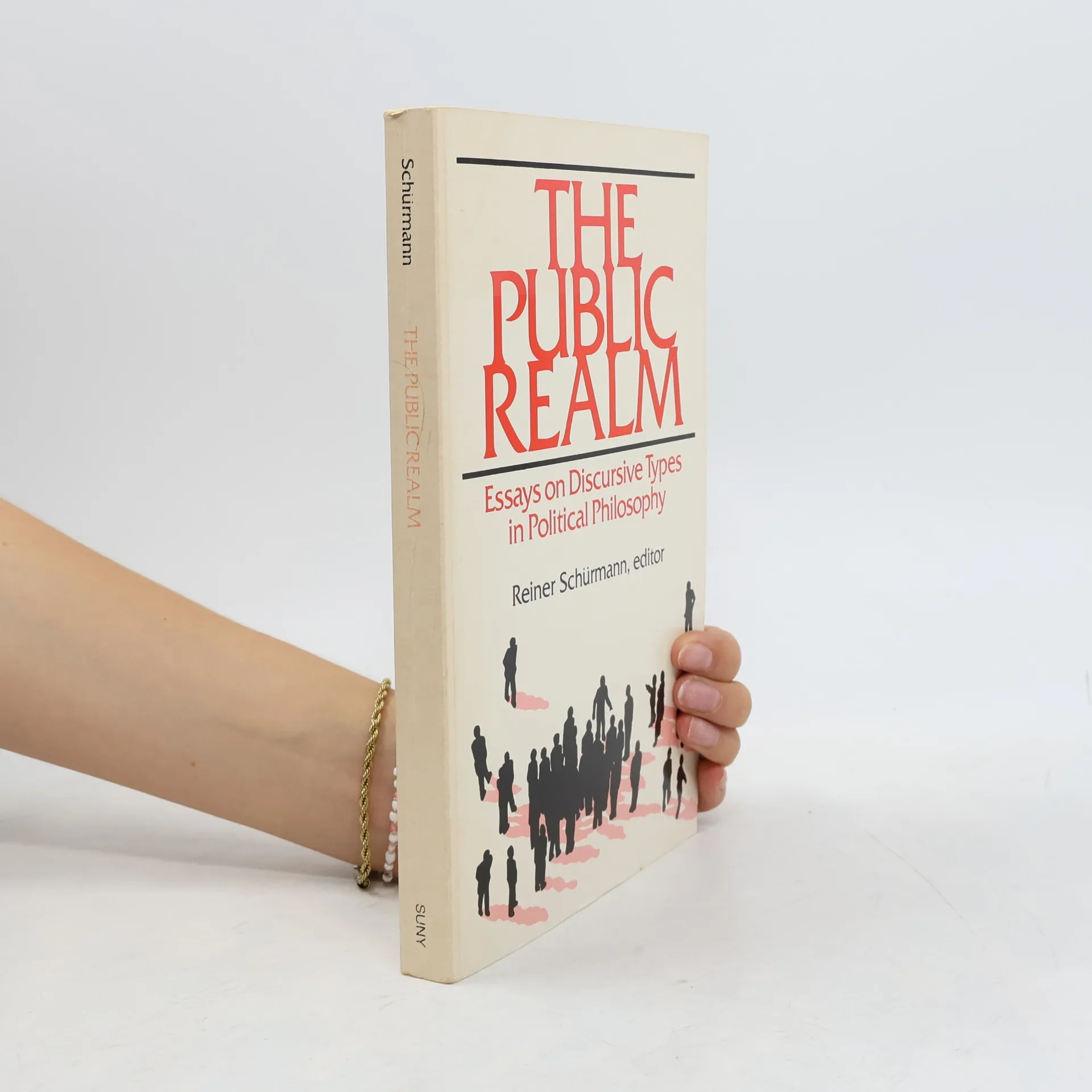
Essays on Discursive Types in Political Philosophy
309pages
11 heures de lecture
This book offers a collection of essays in contemporary political philosophy from a wide range of Continental viewpoints. The authors include some of the most prominent European and European-oriented philosophers and political thinkers of our day. Two sections out of four focus on the debate between prescriptive and descriptive types of political thinking. On the prescriptive or normative side, Karl-Otto Apel, Robert Paul Wolff, Robert Spaemann, Hans Jonas, and Jean-Francois Lyotard discuss current forms of legitimating political life via some ultimate grounding. On the descriptive or phenomenological side, Bernhard Waldenfels, Michel Henry, William J. Richardson, Jurgen Link, and Vincent Descombes argue that an understanding of praxis is always implied as one reaches insights into the life-world; there is no need to either construe or set normative standards for action. The remaining two sections deal with transcendental and institutional types of political philosophy, respectively. Manfred Riedel, Stanley Rosen, Thomas Seebohm, and Ludwig Siep develop Kant's search for "a priori" conditions in the public realm; explicitly or implicitly, they confront the ancient Greek with the modern Enlightenment conceptions of life in public. Lastly, Agnes Heller, Alain Touraine, Reinhart Koselleck, and Bertram Schefold put to work many ways of looking at the life of our institutions.