Jacques Ellul Livres
Jacques Ellul fut un éminent sociologue et théologien dont l'œuvre a principalement exploré la menace pour la liberté humaine posée par la technologie moderne. Son écriture, caractérisée par un ton objectif et érudit, a analysé les phénomènes politiques et sociaux dans une perspective large. Ellul a examiné l'interaction complexe entre la technologie, la société et la psyché humaine, soulignant souvent la relation paradoxale entre le péché et la sacramentalité dans le monde moderne.


À l'Institut d'études politiques de Bordeaux, du temps où Jacques Ellul (1912-1994) y enseigna, ses cours comprenaient des matières inédites autant qu'insolites : la technique, fruit d'une recherche jalonnée de publications au retentissement international, et la Propagande. De 1950 à 1980, un cours sur la Pensée marxiste était également proposé. Il se distinguait des deux précédents par une moindre originalité apparente : Marx n'avait pas attendu Ellul pour figurer dans les cours et traités consacrés aux idées politiques. Mais Ellul fait preuve d'une connaissance approfondie de la pensée de Marx. Son exposé est remarquable de simplicité et de limpidité. Il découvre les écrits de Marx dès l'âge de dix-huit ans. Dès lors, déclara-t-il : «Je n'ai pas trouvé de pensée ou de méthode qui me permette de mieux analyser le monde où je vis. Marx, c'est sûr, a orienté mes interprétations en profondeur.» Ce livre n'est pas ouvrage supplémentaire sur Marx. «Je veux, disait Ellul à ses étudiants, que vous soyez amenés à savoir pourquoi vous seriez pour ou contre.» Tel est le sens de cette publication.
Living Faith
- 324pages
- 12 heures de lecture
The book delves into the essence of Christian faith, distinguishing between superficial religion and authentic faith rooted in divine revelation. Jacques Ellul emphasizes that true Christianity involves a courageous engagement with the Wholly Other God, challenging believers to transcend conventional understanding and embrace a transformative perspective. By examining faith's dynamics, he invites readers to confront their beliefs and seek deeper truths beyond personal circumstances and societal norms.
To Will & To Do, Volume One
- 262pages
- 10 heures de lecture
Exploring the complexities of Good and Evil, this work delves into contemporary Western morality and presents a thought-provoking vision of Christian ethics. The first volume examines the origins of ethical dilemmas, while the second expands on the characteristics of Christian ethics and its connections to biblical law and dogmatic theology. Engaging with notable theologians like Karl Barth and Dietrich Bonhoeffer, this significant contribution offers a fresh perspective on ethical discourse and scriptural interpretation, enriched by a recently discovered manuscript.
Exploring the perspectives of a prominent twentieth-century thinker, this work delves into the complexities of wealth and poverty, addressing pressing contemporary issues. It offers a unique analysis of socio-economic divides and the philosophical implications surrounding them, providing insights that resonate with modern readers. Through thought-provoking discussions, the author invites reflection on the nature of richness and the societal structures that influence our understanding of wealth.
To Will & To Do, Volume Two
- 228pages
- 8 heures de lecture
Exploring the complexities of good and evil, this work by Jacques Ellul delves into contemporary Western morality while presenting a thought-provoking Christian ethics framework. The first volume outlines ethical dilemmas and societal issues, while the second connects ethics with biblical legal texts and dogmatic theology. Engaging with influential thinkers like Karl Barth and Dietrich Bonhoeffer, this two-volume set offers a fresh translation of Ellul's significant theological insights, marking a notable contribution to 20th-century ethical discourse.
The Judgment of Jonah
- 104pages
- 4 heures de lecture
This is not a commentary in the traditional sense. One might call it an existential commentary. An important aim of the author is to bring out the relevance of the story, of the person, mission, and situation of Jonah, to Christians in our own time. Above all, this is a theological, or --more specifically -- a christological commentary. The author's chief aim is to relate the book, not to Christians, but to Christ. Ellul thinks Christ is the center of all Scripture, and he also takes seriously the specific reference which Christ makes to the sign of Jonah. If this reading is correct, and the Bible is indeed a unity, the exposition of Ellul, though not developed in detail, has a distinctive theological contribution to make. Those who want acute theological insight, and are not afraid of plain, hard-hitting application, will read this vivid study with relish and profit. -- From the Preface by G. W. Bromiley
The Subversion of Christianity
- 216pages
- 8 heures de lecture
Pointing to the many contradictions between the Bible and the practice of the church, Jacques Ellul asserts in this provocative and stimulating book that what we today call Christianity is actually far removed from the revelation of God. Successive generations have reinterpreted Scripture and modeled it after their own cultures, thus moving society further from the truth of the original gospel. The church also perverted the gospel message, for instead of simply doing away with pagan practice and belief, it reconstituted the sacred, set up its own religious forms, and thus resacralized the world. Ellul develops several areas in which this perversion is most obvious, including the church's emphasis on moralism and its teaching in the political sphere. The heart of the problem, he says, is that we have not accepted the fact that Christianity is a scandal; we attempt to make it acceptable and easy--and thus pervert its true message. Ultimately, however, Ellul remains hopeful. For, in spite of all that has been done to subvert the message of God, the Holy Spirit continues to move in the world. Christianity, writes Ellul, never carries the day decisively against Christ.
The Technological System
- 378pages
- 14 heures de lecture
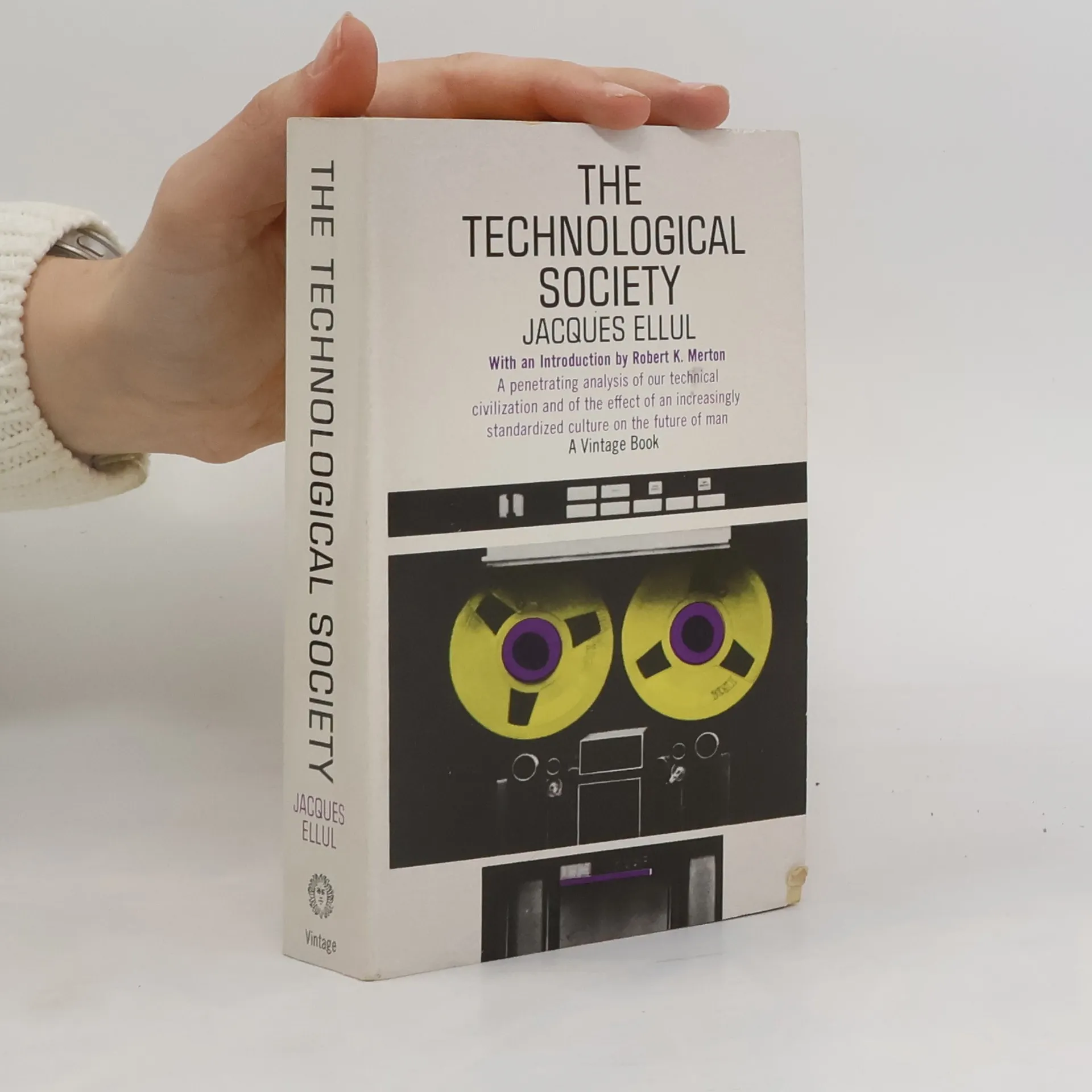
Some 20 years after writing The Technological Society, Jacques Ellul realized how the totalistic dimensions of our modern technological milieu required an additional treatment of the topic. Writing amidst the rise of books in the 1970s on pollution, over-population, and environmental degradation, Ellul found it necessary, once again, to write about the global presence of technology and its far-reaching effects. The Technological System represents a new stage in Ellul’s research. Previously he studied technological society as such; in this book he approaches the topic from a systems perspective wherein he identifies the characteristics of technological phenomena and technological progress in light of system theory. This leads to an entirely new approach to what constitutes the most important event of our society which has decisive bearing on the future of our world. Ellul’s analysis touches on all aspects of modern life, not just those of a scientific or technological order. In the end, readers are compelled to formulate their own opinions and make their own decisions regarding the way a technique-based value system affects every level of human life.
Violence : reflections from a Christian perspective
- 180pages
- 7 heures de lecture
Monograph on historical and contemporary social implications of technology in civilization - discusses economic implications of technology and its relationship to the institutional framework, political doctrines, education, leisure activities and quality of life, etc., as well as its philosophical and sociological aspects, and makes future predictions. Bibliography pp. 437 to 449
Hope in Time of Abandonment
- 330pages
- 12 heures de lecture
Jacques Ellul is recognized as a prominent theologian and social critic, with his writings significantly influencing contemporary thought. Martin Marty noted that Ellul's insights are so profound that he would choose him to articulate the church's agenda, highlighting Ellul's importance in addressing the intersection of faith and societal issues.
Sources and Trajectories
Eight Early Articles by Jacques Ellul That Set the Stage
- 220pages
- 8 heures de lecture
The collection features eight previously untranslated articles by Ellul, showcasing his foundational thoughts on significant concepts. These writings, selected for their historical importance rather than their persuasive clarity, offer insights into his early intellectual development and the evolution of his key ideas.
Desert, Wilderness, Wasteland, and Word
- 142pages
- 5 heures de lecture
Exploring the significance of the desert, this volume presents a newly translated essay by Jacques Ellul, framed within biblical, theological, and ethical contexts. Accompanied by an informative introduction, it includes five critical essays that engage with Ellul's ideas. The collection provides thought-provoking insights into Ellul's writings, resonating with contemporary societal challenges and the search for revitalization amidst desolation.
Autopsy of Revolution
- 312pages
- 11 heures de lecture
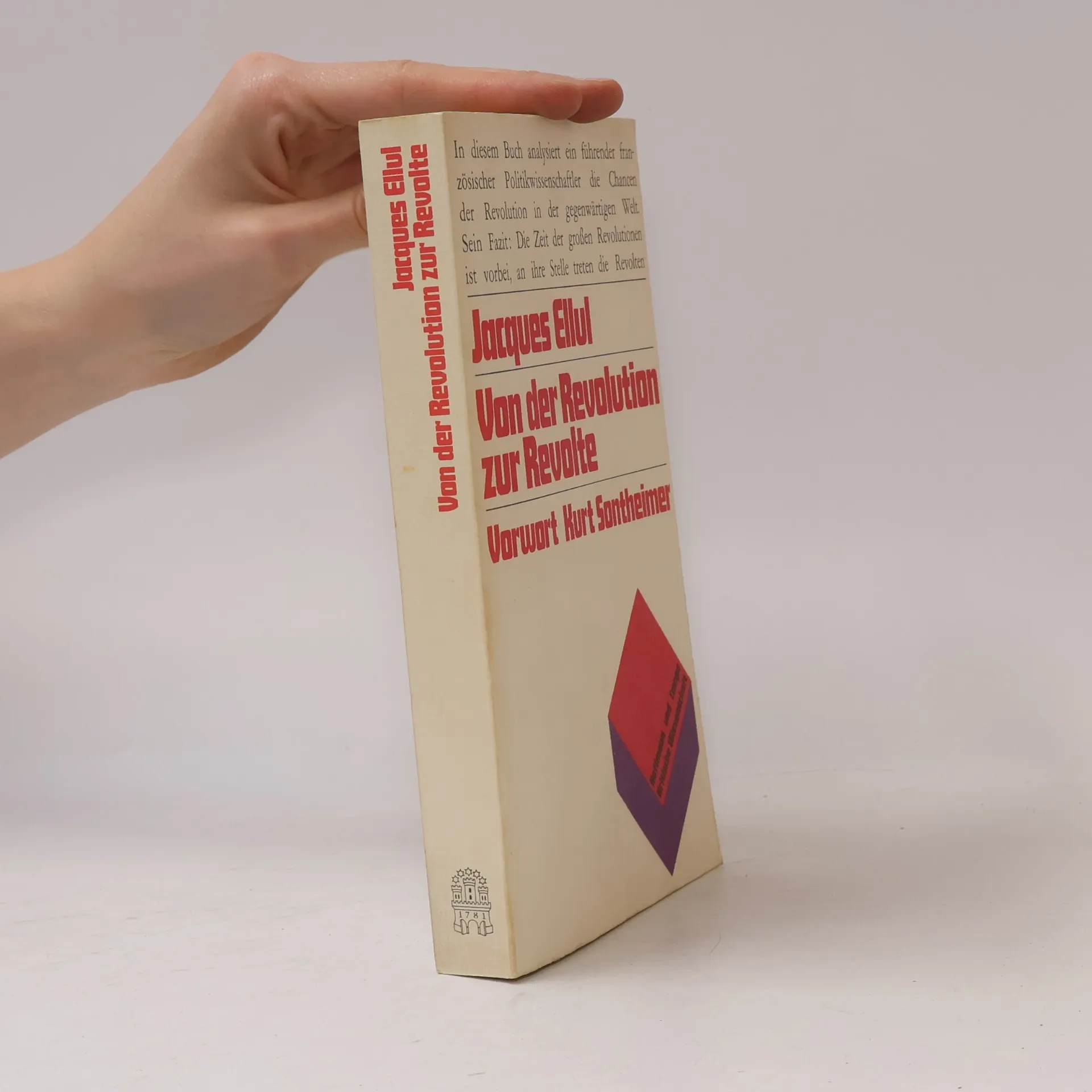
Examining the concept of revolution, the author delves into historical and contemporary perspectives, questioning the effectiveness of modern movements compared to genuine transformative revolutions. He critiques the legacy of Marx, suggesting that it may have distorted our understanding of necessary change. By analyzing past events, he challenges readers to discern between meaningful revolutions and misguided actions fueled by rhetoric. Rather than providing a detailed roadmap, the book aims to clarify thought processes, encouraging a more profound understanding of what true revolution entails for societal survival.
Propaganda. The Formation of Men's Attitudes
- 352pages
- 13 heures de lecture
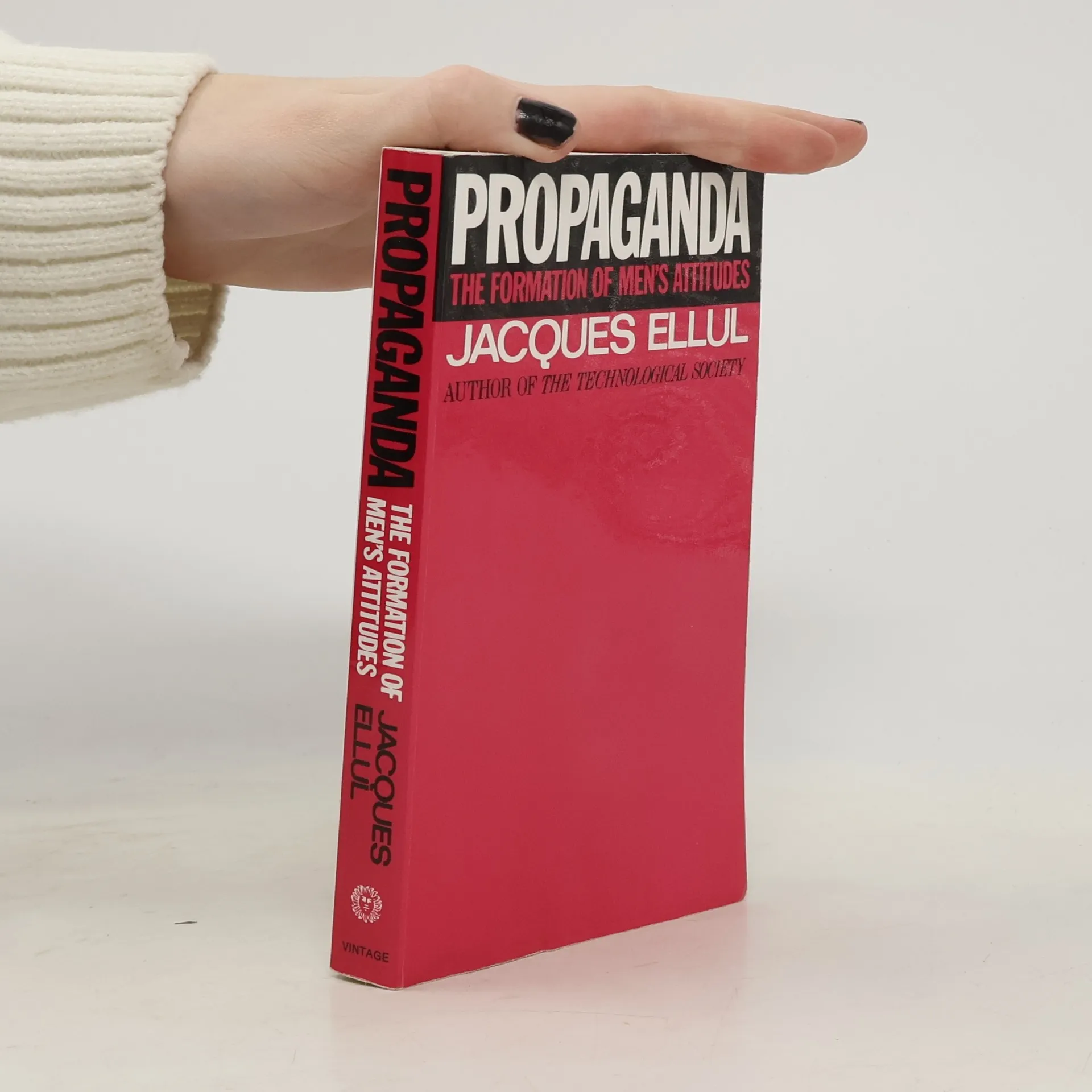
"A far more frightening work than any of the nightmare novels of George Orwell. With the logic which is the great instrument of French thought, [Ellul] explores and attempts to prove the thesis that propaganda, whether its ends are demonstrably good or bad, is not only destructive to democracy, it is perhaps the most serious threat to humanity operating in the modern world."--Los Angeles Times"The theme of Propaganda is quite simply...that when our new technology encompasses any culture or society, the result is propaganda... Ellul has made many splendid contributions in this book."--Book Week"An exhaustive catalog of horrors. It shows how modern, committed man, surrounded and seized by propaganda, more often than not surrenders himself to it only too willingly, especially in democracies--because he is educated for his rule as dupe. 'The most favorable moment to seize a man and influence him,' Ellul writes, 'is when he is alone in the mass; it is at this point that propaganda can be most effective. This is the situation of the 'lonely crowd,' or of isolation in the mass, which is a natural product of modern-day society, which is both used and deepened by the mass media.' "--Los Angeles Free Press
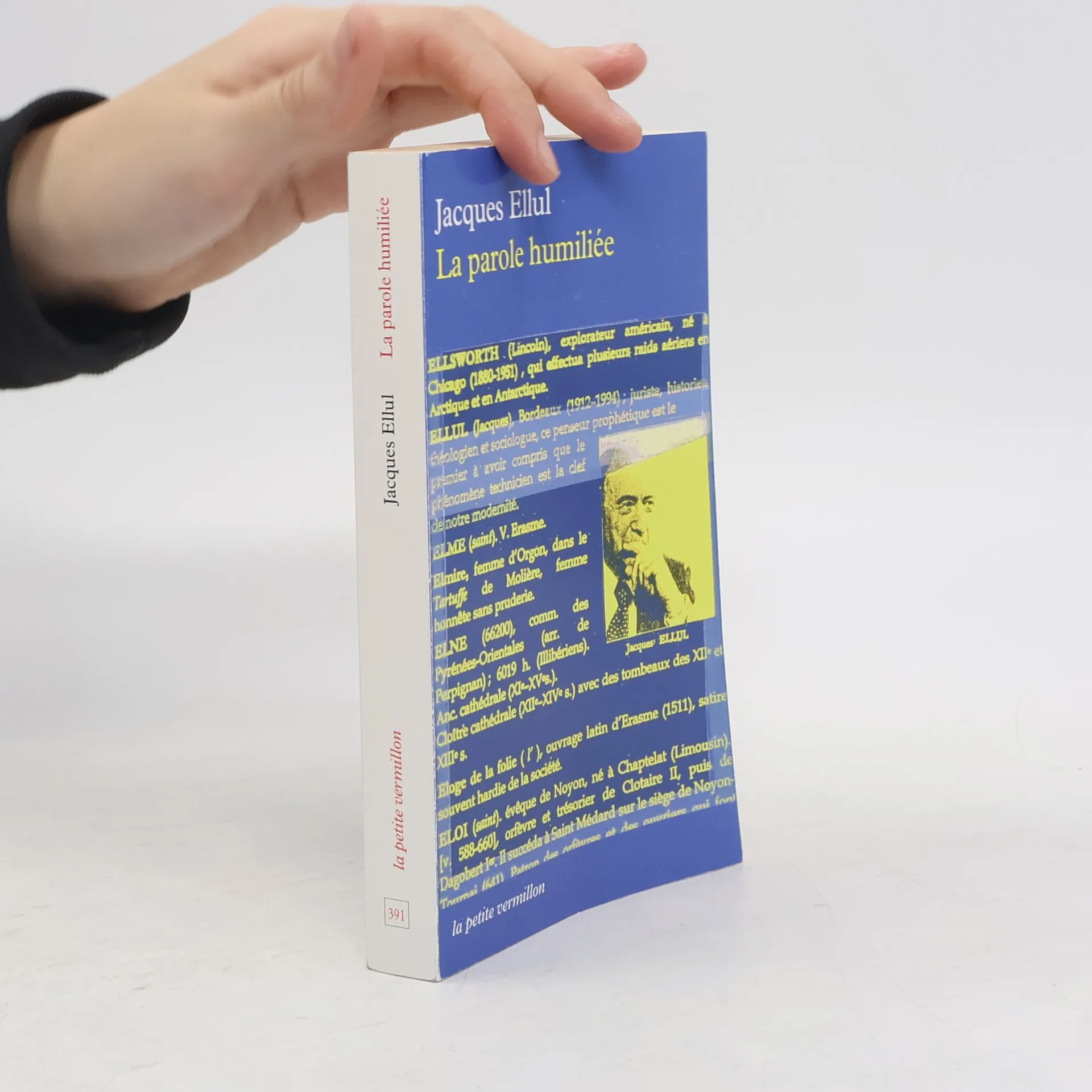
The Humiliation of the Word
- 330pages
- 12 heures de lecture
The book explores the shift in communication from verbal to visual in Western society, emphasizing how this transformation affects perception and interaction. It delves into the implications of a culture increasingly dominated by images, suggesting that the depth of understanding and true dialogue is lost in favor of superficial representation. Through a critical lens, it examines the consequences of this visual dominance on human relationships and societal values.
An Unjust God?
- 134pages
- 5 heures de lecture
This book presents a fresh translation into English, offering readers access to a previously untranslated work. It explores rich themes and intricate character development, immersing the audience in a unique cultural context. The narrative invites readers to experience the author's original voice and style, shedding light on significant historical or social issues. This translation aims to engage both new readers and those familiar with the author's work, providing an opportunity to appreciate the depth and nuances of the text.
The Political Illusion
- 292pages
- 11 heures de lecture
Exploring the concept of politization, the book delves into how contemporary issues have transformed into political matters, suggesting that every problem now carries political significance. Through J. Ellul's insights, it challenges readers to reconsider the intersection of personal and political realms, emphasizing the pervasive influence of politics in everyday life and the implications for society's understanding of various challenges.
Apocalypse
- 278pages
- 10 heures de lecture
“There has never been a book provoking more delirium, foolishness and irrational movements, without any relationship to Jesus Christ [than the Book of Revelation].” —Jacques Ellul, Introduction Known for his trenchant critique of modernity and of those Christians who celebrate their captivity to it, Ellul here cuts to the heart of the theological intention of the Book of Revelation, and thereby reveals the liberating gospel in all its offensiveness. Neither an exhaustive commentary nor a work of historical-exegetical analysis, Apocalypse is a provocative, independent interpretation. Ellul seeks to rescue Revelation from the reassuring and orthodox banality to which commentators often reduce it. The goal is to perceive the totality of the book in its movement and structure. “Architecture in movement” is the key to understanding Revelation’s puzzling but simple message. This edition also comes with a new foreword by Jacob Marques Rollison who provides an essential aid for guiding readers through Ellul’s thorough engagement with Revelation.
The Meaning of the City
- 238pages
- 9 heures de lecture
Exploring the intersection of theology and sociology, the author examines biblical insights to develop a comprehensive theology of the city. This work highlights the relevance of these ancient teachings to contemporary urban life, offering a nuanced perspective on how faith informs the structure and experience of modern cities. Ellul's analysis provides a thoughtful commentary on societal dynamics through a theological lens, making it pertinent for readers interested in urban studies and religious thought.
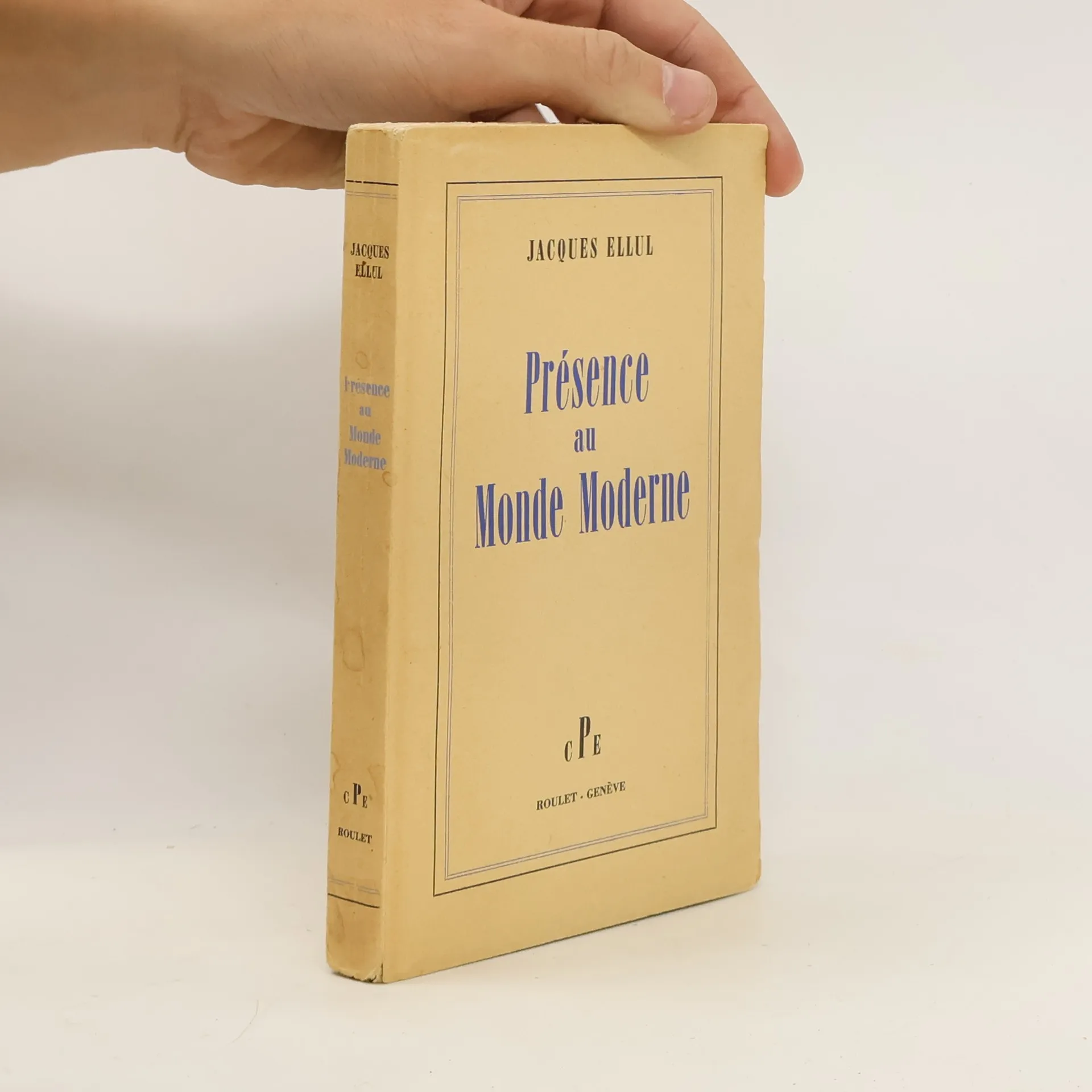
Presence in the Modern World
- 150pages
- 6 heures de lecture
Jacques Ellul's foundational work explores the intersection of social analysis and theology, addressing the complexities of modern challenges like technology and state influence. He encourages a radical awareness of our circumstances, urging Christians to actively dismantle myths and outdated doctrines. By doing so, individuals can embody God's presence and effect meaningful change in society. Originally published in 1948, the book's insights remain relevant, prompting readers to consider their role in shaping the future of civilization amidst contemporary issues.
If You Are the Son of God
- 95pages
- 4 heures de lecture
This significant book, written a few years before his death, presents Ellul's fullest understanding of the meaning of Jesus' life. One finds all of the major themes of Ellul's writings. The first half of this book deals with Jesus' sufferings, which are by no means limited to Good Friday. Through Jesus' identification with "the whole human condition," we are offered the possibility of both enduring and overcoming suffering. Similarly, the temptations are understood beyond the wilderness temptation narrative since Jesus experiences them throughout his ministry. Ellul believes temptations are ultimately human avenues for tempting God, and so focuses on the discussion power and "non-power," be it on personal or political levels. Appropriately, Ellul enters into the passion narrative not simply in the context of suffering but in the context of temptation, where Jesus could have easily "proved his divinity," but chose instead to reveal both the character and way of God.
Anarchy and Christianity
- 114pages
- 4 heures de lecture
Jacque Ellul blends politics, theology, history, and exposition in this analysis of the relationship between political anarchy and biblical faith. While he clarifies the views of each and how they can be related, his aim is not to proselytize either anarchists into Christianity or Christians into anarchy. On the one hand, suggests Ellul, anarchists need to understand that much of their criticism of Christianity applies only to the form of religion that developed, not to biblical faith. Christians, on the other hand, need to look at the biblical texts and not reject anarchy as a political option, for it seems closest to biblical thinking. After charting the background of his own interest in the subject, Ellul defines what he means by anarchy: the nonviolent repudiation of authority. He goes on to look at the Bible as the source of anarchy (in the sense of nondomination, not disorder), working through Old Testament history, Jesus' ministry, and finally the early church's view of power as reflected in the New Testament writings.
To Will and To Do Vol I
- 264pages
- 10 heures de lecture
Jacques Ellul's landmark theological work, now available in English for the first time, offers a profound exploration of Christian ethics. This publication includes a fresh translation of Volume One and the first-ever English translation of Volume Two, enhanced by recent insights and a newly discovered manuscript. Together, these volumes lay the foundation for Ellul's ambitious four-part examination of ethics, providing readers with a comprehensive understanding of his thought and its relevance to contemporary issues.
Reason for Being
- 322pages
- 12 heures de lecture
Jacques Ellul offers a profound exploration of Ecclesiastes, drawing on his extensive theological and sociological insights. This work serves as his final reflection, encapsulating decades of contemplation on themes of wisdom, vanity, and the divine presence. Ellul's unique perspective as a leading thinker of the twentieth century invites readers to engage deeply with the biblical text, making it a significant contribution to theological discourse.
Islam and Judeo-Christianity
- 124pages
- 5 heures de lecture
Exploring the relationship between Islam and Judeo-Christianity, the book critiques the commonly accepted themes of shared heritage, monotheism, and their status as "religions of the book." Through incisive analysis, it reveals a deeper divergence among these faiths, challenging the notion of commonality and exposing a tendency towards conformism. The author encourages readers to reconsider the simplistic narratives that often unify these religions, inviting a more nuanced understanding of their differences and complexities.
Theology and Technique
- 298pages
- 11 heures de lecture
Exploring the intersection of radical theology and sociological critique, this posthumous volume offers a fresh perspective on Jacques Ellul's work. Compiled by his family and scholars, it includes previously published and unpublished essays that reflect Ellul's thought from the 1970s. Frederic Rognon's insightful introduction enhances the reader's understanding, while Christian Roy's translation skillfully conveys the nuances of the original French text. This book is vital for anyone seeking to grasp the depth of Ellul's Christian engagement with modern challenges.
In To Will and To Do, twentieth-century French thinker Jacques Ellul presented his landmark theological contribution, yet the full text has never before been available in English. Incorporating recent insights on Ellul, and benefitting from the discovery of a lost manuscript, this new publication remedies this, combining a fresh translation of Volume One with a first English translation of Volume Two. Together, the two volumes constitute the first part of Ellul's planned four-part treatment of Christian ethics. In Volume Two, Ellul examines the origin of the problem of Good and Evil, surveys the contemporary morality of Western society, and provocatively sketches the paradox of an impossible and yet necessary Christian ethics. In Volume Two, he carries this discussion forward, outlining the characteristics and conditions of Christian ethics, and analysing the relationship between ethics, the legal texts of the Bible, and dogmatic theology. He concludes by reimagining the theological use of the ‘analogy of faith’ for scriptural interpretation. Throughout, Ellul remains in dialogue with Karl Barth, Dietrich Bonhoeffer, Paul Ricoeur and others, helping to cement To Will and To Do as a major intervention in twentieth-century theological ethics.
Propaganda. Wie die öffentliche Meinung entsteht und geformt wird
- 450pages
- 16 heures de lecture
Die Natur der Propaganda besteht nach dem großen Philosophen Jacques Ellul in der Anpassung des Individuums an eine Gesellschaft, die darauf abzielt, das Individuum dienstbar und konform zu machen. "Mit der Logik, die ein großartiges Instrument des französischen Denkens ist, versucht Ellul seine These zu beweisen, dass Propaganda ungeachtet positiver oder negativer Intentionen nicht nur eine zerstörerische Wirkung für die Demokratie hat, sondern vielleicht die größte Gefahr für die Menschheit der modernen Welt ist," schrieb Robert R. Kirsch zum Erscheinen der Originalausgabe 1962 in der Los Angeles Times. Im Westend Verlag erscheint nun erstmals die deutsche Übersetzung dieses wichtigen Standardwerks zur Propagandaforschung.
Von der Revolution zur Revolte
- 279pages
- 10 heures de lecture