



En savoir plus sur le livre
This significantly expanded and updated new edition of a widely used text on reinforcement learning, a key area in artificial intelligence, presents a computational approach where an agent aims to maximize rewards while navigating a complex environment. Richard Sutton and Andrew Barto offer a clear account of the field's essential concepts and algorithms. The second edition introduces new topics and updates existing ones, maintaining a focus on core online learning algorithms, with mathematical content highlighted in shaded boxes. Part I explores reinforcement learning within the tabular case, introducing new algorithms such as UCB, Expected Sarsa, and Double Learning. Part II advances these concepts to function approximation, featuring new sections on artificial neural networks and the Fourier basis, along with an expanded discussion on off-policy learning and policy-gradient methods. Part III includes new chapters examining reinforcement learning's connections to psychology and neuroscience, as well as an updated case studies chapter covering AlphaGo, AlphaGo Zero, Atari game playing, and IBM Watson's wagering strategy. The final chapter addresses the future societal impacts of reinforcement learning.



Achat du livre
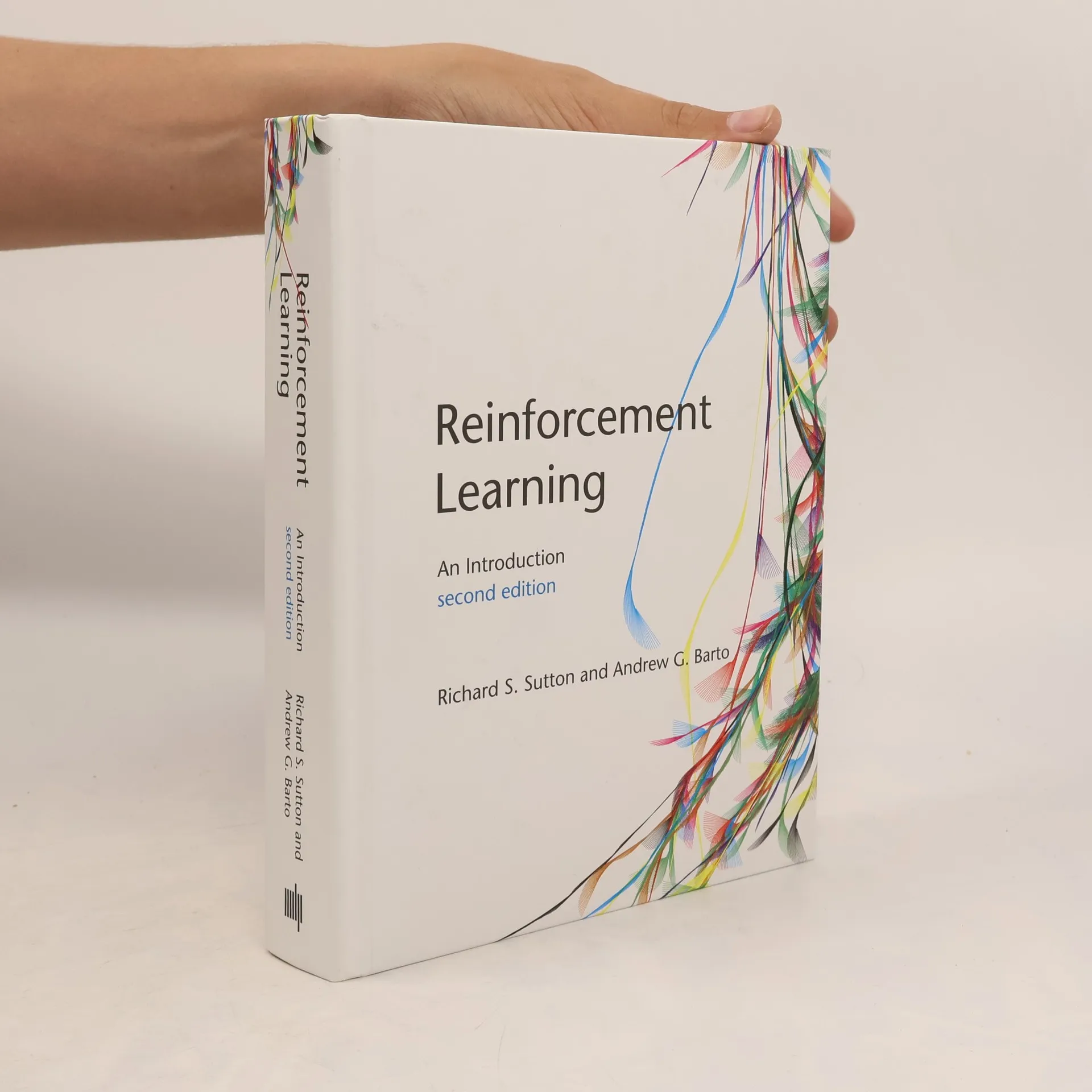
Reinforcement Learning, Andrew G Barto, Richard S. Sutton
- Langue

- Année de publication
- 2018
- Reliure
- (rigide)
Modes de paiement
Il manque plus que ton avis ici.
- Sous-titre
- An Introduction - Second Edition
- Langue
- Anglais
- Auteurs
- Andrew G Barto, Richard S. Sutton
- Éditeur
- MIT Press
- Publié
- 2018
- Format
- rigide
- Pages
- 552
- ISBN10
- 0262039249
- ISBN13
- 9780262039246
- Mots clés
- Nonfiction, Manuels, Technologie & Ingénierie, Informatique & Internet, Science, Technologie, Intelligence Artificielle
- Évaluation
- 4,55 sur 5
- Description
- This significantly expanded and updated new edition of a widely used text on reinforcement learning, a key area in artificial intelligence, presents a computational approach where an agent aims to maximize rewards while navigating a complex environment. Richard Sutton and Andrew Barto offer a clear account of the field's essential concepts and algorithms. The second edition introduces new topics and updates existing ones, maintaining a focus on core online learning algorithms, with mathematical content highlighted in shaded boxes. Part I explores reinforcement learning within the tabular case, introducing new algorithms such as UCB, Expected Sarsa, and Double Learning. Part II advances these concepts to function approximation, featuring new sections on artificial neural networks and the Fourier basis, along with an expanded discussion on off-policy learning and policy-gradient methods. Part III includes new chapters examining reinforcement learning's connections to psychology and neuroscience, as well as an updated case studies chapter covering AlphaGo, AlphaGo Zero, Atari game playing, and IBM Watson's wagering strategy. The final chapter addresses the future societal impacts of reinforcement learning.